Quantcast

Tuesday, October 18, 2011

Analysis of the new 2012 Powerball game changes. Part 1: Game summary & prize evaluation

In late June, the MUSL announced that it was going to change the format of Powerball. Since most available literature simply reiterates the notice of changes, we believe that players are wondering whether: these new changes are good for them, and if they should be eager to purchase tickets at the increased costs.


To help players understand the implications of these changes and whether they should continue to play the new Powerball game, we are writing a 3 part series of posts that:
Originally, we intended to include all of these topics in one post. But, we quickly realized that the length of the post was too long, thus we are breaking the analysis into these 3 parts.

This is Part 1. Its purpose is to explain what the new changes are, and what they will mean to lottery players with regard to prizes that the new Powerball game offers.

The 2012 Powerball Changes
The table below summarizes the array of the Powerball changes. Most notably, players will find that the cost of tickets will increase from $1 to $2 each and that the minimum jackpot will increase to $40 million.

Summary of 2012 Powerball Changes Power Play Prizes Fixed
Starting jackpot at $40 million (up from $20 million)
Match 5 prize fixed at $1 million (up from $200,000)
Matching Powerball Only prize at $4 (up from $3)
White Ball Remains at 1 to 59 (no change)
Powerballs 1 to 35 (down from 39)
Regular Ticket Costs $2 (up from $1)
Powerplay Ticket Costs $3 (up from $2)
Power Play Prize Amounts  Now Fixed (no multiples)
$1M Prize to $2M (2x)
$10,000 Prize to $40,000 (4x)
$100 Prizes to $200 (2x)
$7 Prize to $14 (2x)
$4 Prize to $12 (3x)

Because the number of white balls remains the same, the chances of winning the 2nd tier prize of 5+0 remains the same at 1 in 5,153,632.65. However, since the number of Powerballs decreases by 4 to 35, the overall chance of winning the Powerball jackpot will decrease by approximately 20 million to 1 in 175,223,510.

Implementation Date
Implementation of the new game format will coincide with the Powerball's 20th anniversary. The expected sales date for the new Powerball format is January 15, 2012 and the first drawing will be January 18, 2012.

Why the Changes? Powerball's Reasoning.
On its FAQ page, Powerball identified 9 reasons for modifying the game. The first eight provide their rationale why players will continue to purchase tickets at the increased ticket cost. Each of these addresses the players' psychology and takes advantage of their vulnerability. The last reason, "Game variety" is something that must be questioned.
  1. Scratch tickets costing $2, $3, $5, $10, $20 and $50 all sell
  2. Powerball price was fixed for 20 years
  3. Ticket sales increase more rapidly when jackpot is higher
  4. Jackpots should increase by $10M each drawing, reaching players "buy" level more quickly
  5. Average jackpot of new format will be $255 million (was $141 million)
  6. There will be more millionaires since all match 5+0 winners will receive $1M.
  7. A fixed Power Play takes uncertainty out of winning. Those matching 5+0 will get $2M, enough to pay taxes and still keep $1M
  8. There will be more winners.
  9. Game variety.
Game Variety?
With the new Powerball odds reduced to 1 in 175+ million, it is easy to conclude that the overall game format is very similar to Mega Millions which also boasts a 1 in 175+ million chance of winning. The major difference between the games will be: the ticket price; and the prizes for the top two prizes.

The table below summarizes the differences between the two games in a side by side manner. Powerball is shown in the light blue columns, and Mega Millions is shown in the pink columns.

Match MM 5/56+1/46
Odds
PB 5/59+1/35
Odds
Winners
MM
Winners
PB
Prize $
MM
Prize $
PB
Prize $
Megaplier
Prize $
Power Play
5+1 175,711,536.00 175,223,510.00 1 1 $12,000,000 $40,000,000 $12,000,000 $40,000,000
5+0 3,904,700.80 5,153,632.65 45 34 $250,000 $1,000,000 $1,000,000 $2,000,000
4+1 689,064.85 648,975.96 255 270 $10,000 $10,000 $34,762 $40,000
4+0 15,312.55 19,087.53 11,475 9,180 $150 $100 $521 $200
3+1 13,781.30 12,244.83 12,750 14,310 $150 $100 $521 $200
3+0 306.25 360.14 573,750 486,540 $7 $7 $24 $14
2+1 843.75 706.43 208,250 248,040 $10 $7 $35 $14
2+0 18.75 20.78

1+1 140.63 110.81 1,249,500 1,581,255 $3 $4 $10 $12
1+0 3.13 3.26


0+1 74.8 55.41 2,349,060 3,162,510 $2 $4 $7 $12
0+0 1.66 1.63


Illustrated are the odds (or chances), number of winners, prize payout for normal tickets, and prize payout for the multiplier (Megaplier and Power Play) tickets of both games.

The six graphs below illustrate various portions of this table, showing the Powerball players percent gain or loss in each of these pairs of information. The percentages are calculated by: dividing the Powerball values by the associated Mega Millions values; subtracting 1; and then multiplying by 100.


1. Compare Overall Odds of both Games
Chart P1 shows the differences between the odds of both games. As shown, the chance of winning the Powerball jackpot is only 0.3% less than winning the Mega Million jackpot (so they are about the same). However, odds of matching anywhere from 5 to 1 of the white balls and not the Powerball are much more difficult in Powerball. It is 32% harder to win the 2nd tier prize of 5+0, 24.7% harder to match 4+0, and 17.6% harder to obtain a 3+0 winner in Powerball.

But when a Powerball is matched, it is easier to win a prize. That is because there are less Powerballs than Megaballs. As shown in red, it is 5.8% easier to match a Powerball 4+1, 11.1% to easier for 3+1, and so on. Matching the Powerball only is 25.9% easier in Powerball.

If you are one of the typical 96.9% of players, you will probably not win anything at all. In Powerball, you are 1.8% more likely not to match any balls in Powerball than in Mega Millions. But, on the overall, there will be 0.6% more winners in Powerball.


2. Compare Total Winners in both Games
Chart P2 illustrates the differences between the numbers of winners in each category. In effect, it is the mirror image of the above odds comparison. In both games, there is only 1 jackpot winner, and no winners for matching 0, 1, or 2 white balls and not the bonus ball. This means players are indifferent to those categories.

Excluding the jackpot, Powerball offers more opportunities to win a prize whenever the Powerball bonus is matched. In these cases, the Powerball advantage ranges from 5.9% to 34.6%.

When the player does not match the bonus Powerball, Mega Millions outperforms (in red). There will be 24.4% more 2nd tier Mega Millions winners than Powerball. Similarly, those matching 4+0 or 3+0 are 20% and 15.2% more likely to win a prize in Mega Millions than in Powerball.

These differences are all explained by the fact that there are less white balls in Mega Millions and less bonus balls in Powerball.


3. Compare PB to MM Prizes per Ticket
Chart P3 summarizes the difference in prize winnings per ticket between the two games.

This verifies Powerball's goal of offering higher jackpot and 2nd tier prizes when the jackpot is set to minimum. Those who win a Powerball jackpot will collect 233.3% more than the Mega Millions winner, and will get 300% more when matching 5 white only.

The Powerball winning ticket also has the advantage for those matching the Powerball and 1 or 0 white balls which will pay out more than its rival game.

Those in the middle are better off with Mega Millions as players matching 4+0, 3+1, or 2+1 balls will receive approximately 1/3 larger prizes.

There is no difference in winnings for players matching 4+1 or 3+0 in either game. And, of course, all losing tickets will collect an even $0.


4. Compare PB to MM Prizes by Dollar Spent
Since Powerball tickets will cost $2 each and Mega Millions only $1, it is necessary to normalize the prize winnings to dollar spent.

Chart P4 illustrates this difference. Here we see that Powerball only pays out more for the jackpot and 2nd tier winners.

All other lower tier Powerball prizes pay substantially less than or equal to their associated Mega Millions counterparts.


5. Compare PB Ticket to MM Megaplier Ticket
So what happens if a player buys a $2 Megaplier ticket in comparison to the $2 Powerball ticket?

In each case, the player pays $2 either way. But, except for the 1st prize, Powerball players receive lesser prize amounts. Depending on their winning, a player will receive 42.5% to 80.8% less than a Mega Millions winner.

If the player is lucky enough to claim the winning jackpot ticket, the Powerball winner will be paid 233.3% more. Whereas, it you match all 5 white balls and not the bonus ball, you will win the same amount of money in both games.


6. Compare PB Powerplay to MM Megaplier
Lastly, a player may wish to buy the multiplier options in both games, which means he will spend $3 for a Powerball Powerplay ticket, and $2 for a Mega Millions Megaplier ticket.

Here we see a pattern similar to that of buying a single Powerball and Mega Millions ticket.

In this case, Chart P6 summarizes the winning payouts. Here, the Powerball player will win more if they win any of the first 3 prizes or the bottom two.

Those whose tickets fall in the middle will receive smaller Powerball prizes compared to Mega Millions.


Summary
In summary, we can agree that the Powerball game will pay out higher jackpot prizes. However, we do not believe the extra cost enhances the desirability of the prize.

Players have to remember that approximately 97% of all tickets sold will be losers. This means that only 3% will win something.

Since the chances of winning the jackpot is about the same in both Mega Millions and Powerball, we believe that it is more beneficial for players to buy 2 individual Mega Millions tickets instead of 1 Powerball ticket. By doing this, the Mega Millions player will have twice as many chances of winning a prize compared to the Powerball player. On a per dollar basis, the prize structure for Mega Millions is more attractive as well.

However, if your goal is to win a prize of at least $1 million, then it is better to buy 1 Mega Millions ticket with the Megaplier option. Except for the jackpot, these players lucky enough to have a winning ticket will always win more than the Powerball ticket holder.


Sources:
Powerball® Enhancements Start January 2012 (Nebraska Lottery)
Powerball FAQ/History/News (Official Site)
How 2009 Powerball Changes Effect You

Tuesday, September 6, 2011

Our 5th Year (Wooden) Anniversary (2006-2011)

The month of September marks the 5th year anniversary of our website: Lottery Power Picks.

When we launched our site in 2006, we never imagined the difficulties we would face, nor the amount of time it would require. Like many others, we simply thought that when we launched, it would be an instant success. We aimed our focus at various forums and asked participants to visit us. However, we were quickly dismissed by many who noted that our site didn't even appear in a Google search.

Since then, we have learned to respect the hard work of others and ceased promoting our website within other lottery sites. Instead, we advertised a bit and remained focused on building a comprehensive set of analytical tools to help the general lottery playing population.

Now, five years later, we can boast of a registered membership that exceeds 3,400 players. And, during the past year, we've had over 50 Major Winners: (see our Lottery Power Picks Winners page). The largest prizes that members won were during 2010 to 2011 were:
  • $10,000 Mega Millions ( Oct 12 2010 )
  • C$5,373.70 Lotto Max ( Jan 14 2011 )
  • C$1,187.40 Lotto 649 ( Mar 19 2011 )
  • $500 Hot Lotto ( Oct 23 2010 )
Our development efforts during this past year were aimed at learning to utilize and incorporate Google Visualizations into our pages. We believe these tools assist in providing user interaction with both graphic and tabular data. One of the first development projects was to examine the rotation of the earth and moon around the sun:


While this type of work does not appear not to relate to lotteries, its information has helped us to formulate future analytic solutions for us to address.

This year we have concentrated on adding new functionality and analysis. For example, we have added a new navigation bar at the top of most pages for your use in locating our information. In addition, we have written a variety of full wheel calculators that lets you compare your expenditures versus you potential winnings. Our Pick 3 pages have gained momentum this past year, particularly after we added a number of other states. Of course, we have had to revise our previously released pages whenever a lottery modified their game format (Thunderball, Mega Million, and Euro Millions).

A subset of articles and pages we published this past year are listed below for your reference.
Examples of new functionality we are adding to existing pages can be found in:
Unfortunately, these pages are best viewed in Firefox. We are aware that other browsers display differently and are trying to get these to work in all browsers.

We wish to thank all of you who have written to us during the past year and have: informed us of problems, told us of their winnings, and requested new functionality.

And most importantly, we wish to thank all of you for being loyal followers of our site and referencing our information daily. We will continue to improve our content and hope we bring you success in winning the lottery prizes!

Sunday, August 21, 2011

Same 5 lottery numbers are drawn on same night in two different lottery games

As we were entering the lottery numbers for Hot Lotto, we realized that the numbers looked familiar. So we reviewed our other results and saw that the UK Thunderball selected the same 5 white balls earlier that evening. The numbers drawn for both Hot Lotto and Thunderball on Saturday, August 20, 2011 were:


GameWhite
Numbers Drawn
Thunderball
Hot Ball
Thunderball 6 7 11 22 3310
Hot Lotto6 7 11 22 3313


The white balls are the same!

The two games are identical in the white ball format because they both require players to select 5 of 39 white balls.

Only the bonus balls portion of the games are different. Thunderball contains 14 Thunderballs, whereas Hot Lotto contains 19 Hot balls.

On the white ball side, there are 575,757 unique combinations in each game. To select the same winning number more than once seems nearly impossible, but drawing it on the same night in two different lottery games across the pond is a miracle.


Monday, June 27, 2011

How Irish Lottery Players Win Money Playing Lotto 5-4-3-2-1

One game that all Irish lottery players should be playing is Lotto 5-4-3-2-1. This is because the numbers utilized are based the Irish Lotto (Lotto Plus 1, and Lotto Plus 2) results and the winning payouts are substantially high.

To play Lotto 5-4-3-2-1, a player chooses five numbers and selects which game results they would like to match. We recommend that the Irish Lotto always be used because of the variety of analytical analysis available. To win a prize, the player must match one of more of the numbers selected in the Lotto drawing.

For this purpose, the player has the option to include or not include the bonus number. We recommend that the bonus number NOT be used because the payouts are higher. The table below illustrates the Lotto 5-4-3-2-1 payouts for both the 6 Number Game (recommended) and the 7 Number Game (not recommended)


Next, using the results displayed in our Irish Lotto Hot Cold Number Analysis page, we currently have identified 5 hot numbers. These are:

02 04 06 12 38

These are the numbers that you should play in the 6 Number Lotto 5-4-3-2-1 Lottery Game. Based on our results analysis, a player using this 5 number combination would have won €1,482 in the last 3 month (26 week) period. Your cash outlay would have been €26, and you would have earned a €1,456 profit. The breakdown of winnings would have been
  • Match 1: Seven times (7 * €6 = €42)
  • Match 2; Nine times ( 9 * €40 = €360), and
  • Match 3: Two times ( 2 * €540 = €1,080).
So, if you live in Ireland and play the Irish Lotto, we highly recommend you play the above numbers in the Lotto 5-4-3-2-1 Game.

Tuesday, May 24, 2011

Mega Millions Picks All Hot Numbers Again

For the second time in less than 6 months, the Mega Millions lottery has drawn all Hot white ball numbers. In the May 24, 2011 Friday night drawing, the 5 hot white balls: 10 17 19 45 48 were picked. That night, the annuity jackpot was $16 million.

MM HC Results 20110520MM HC Numbers 20110520

Prior to that drawing, we classified 11 white balls as being hot. If a full wheel of these numbers was played, there would have been 462 unique combinations. If all these were purchased, the cost would have been $462 and the winner would have earned $250,000. However, if the player purchased the Megaplier as well, a cool $1 million would have won for a mere $924 investment.  Unfortunately, the Mega Ball that night was the number 30, which was classified as a neutral number.

The last time all hot balls were drawn in the Mega Millions was Tuesday, December 17, 2010. In that drawing, the annuity prize offered was $133M, but it was not won. You can read our previous article All Hot Numbers Picked in Last Mega Millions Drawing for reference.

Tuesday, April 19, 2011

Investing or Gambling? Part 10: Conclusion

During the past 9 weeks, we have presented a series of articles questioning whether investing and gambling are synonymous.
  • Week 1, we provided an overview of the topic and laid out an outline of the posts to follow.
  • Week 2 we defined investing and gambling. We noted the three main distinctions that an investor has verses a gambler: ownership of an asset; value derived from market demands; and option to sell. We also summarized the two similarities: success is based on probabilities; and the future outcomes are unknown.
  • In Week 3, we discussed why this topic is important at this time. We pointed out that because of the weak U.S. economy, many people are desperate to earn a living and that temptation to invest and gamble is everywhere.
  • Week 4 concentrated on the differences between investing and gambling. Again, we reiterated that investing involves ownership but gambling does not. Also, we indicated that gambling infers fun while investing infers work.
  • Week 5's article focused on a few of the successful gamblers and investors or our time. Most of these individuals are currently earning substantial livings concentrating on both of these disciplines. We pointed out that most: were very highly educated and possessed a deep knowledge of mathematics; worked very hard to refine their skills; and dedicated many years of their lives to perfecting their livelihood.
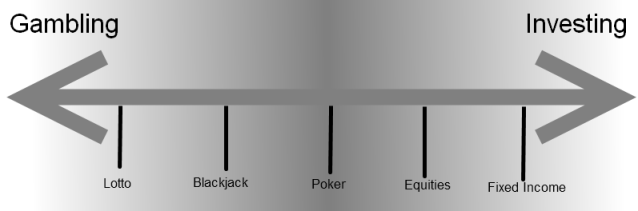
  • In Week 6, we presented the various investment products that investors and gamblers have the options buy or play. Investors can be conservative and focus only on CDs or Bonds, or they can get excitement and thrills buying derivatives, commodities, collectibles, or other unique items. Gamblers can also vary their risk by buying lottery tickets, analyzing sporting events, playing board games or casino poker.
  • Week 7's discussion focused on the profile of typical investors and gamblers. We noted that  successful gamblers were more: in control of their spending; optimistic about the future; and were more prepared for retirement. Both professionals were highly educated and made analytical decisions. Neither view their profession as gambling.
  • In Week 8, we indicated the two mathematical skills that both investors and gamblers possessed were the ability to mentally: construct complex decision trees; and know the probability of success of each outcome by heart.
  • Lastly, Week 9 presented the concept of manipulation in the two different industries. Our current belief is that the gambling industry is more regulated and less likely to be manipulated. Whereas, the investment industry is regulated only on a macro level, which leaves the doors to manipulation wide open.
In our opinion, we believe that investing is much more risky than gambling is to the common man. Both professions are comprised of individuals whose sole purpose is to earn a substantial amount of money. Those who gamble usually understand their odds of winning and of losing. They typically wager small amounts of money and participate for the enjoyment or entertainment factor.

However, these same individuals invest comparatively large sums of money in the stock market and 401k accounts. Rarely do they understand the products they are buying or the potential risks of losing money. Far too many people have lost their children's educational funds during the collapse of the dot.com bubble, and are now underwater on their home's real estate investment.

Those who are against legalized gambling will point to the losses of the compulsive gambler, saying how those individuals are sick, irresponsible, and have lost everything.

Yet the losses of our entire population during the recent financial meltdown serve as a lesson in understanding risk. We truly believe that you should never buy anything that you do not understand, and more importantly, never invest with only the hope of attaining a win-fall, because this is when investing becomes simply another word for gambling.

Tuesday, April 12, 2011

Investing or Gambling? Part 9: Is Manipulation Possible?

The Last Days of Lehman BrothersImage via Wikipedia
So now that we have: defined the differences between gambling and investing; looked at successful professionals of both disciplines; listed a subset of gambling and investing instruments; and identified the mathematical foundations of both, we are ready to ask ourselves:
Can Gambling & Investing 
Outcomes be Manipulated?

Given the recent events that have driven oil prices through the roof once again, and the exposure of the Madoff Ponzi scheme, we can quickly agree that certain investments may indeed be manipulated.  Additionally, we have all been taught the risks of gambling with regard to: horse races being fixed; people who cheat at poker; three card monte; card sharks; pool hustlers, etc.

Absolutely!

Unless the common investor or gambler understands the outside risks that they face from their competition, they are merely sitting ducks for the professionals who specialize in certain products.

While it is beyond the scope of this article to identify all places where an market prices and game outcomes can be manipulated, we believe it is important to illustrate some of the potential schemes that are aimed at taking your money.
  • Buying Commodities. With all the turmoil in the world, the price of gold has increased dramatically. As this metal increased in value, many small Gold retailers have aggressively advertised the reasons why you should buy gold. However, most of these firms are only cashing in on the buying frenzy. They do not care if the price increases or declines. They will make a commission either way. You are the one that will lose.
  • Same is true if you buy stocks as an individual investor. For every 100 shares that you buy, someone else may be buying thousands. Most of those who buy in large quantities have much more timely information than you. Unless you can time the market right, there is a good chance that the market will turn against you. All you can do is to go along for the ride.
  • Playing casino poker. If you enjoy visiting a casino and playing at a poker table, chances are that you are playing against one or more professionals. These folks play every day and this is their living. They usually have much more money than the common visitor and can therefore influence your playing decisions. You may be lucky to win a few good hands, but in the long run, you will probably lose most of your money to these individuals.
  • Horse racing. This is a sports gambling event that you bet against others. Many of those study the past performances and understand the subtleties of individual tracks. However, your main competition is the horse owner, trainer, track workers, and rider community. These are the folks who make a living off their investment. While many of the owners may not make a profit, they will probably not lose money either. This is a small community and they keep everyone in business by taking your hard earned money when you least expect a loss.
As a small investor or gambler, you are always at the mercy of those professionals who specialize in a particular investment type, sporting, or gambling game. Always be aware that they have more money than you which can alter the payout odds or investment prices. Most of the people working against you are in business to earn their own living. As such, they are not targeting you as an individual, but rather you as a member of a class of the uninformed.
Enhanced by Zemanta

Tuesday, April 5, 2011

Investing or Gambling? Part 8: Mathematical Similarities

Mathematics plays an important role in the decision making of both investors and gamblers. While some of the analytical quantification methods are substantially different, we believe that there are two common techniques that inherently similar. These are:
  • Decision Trees, and
  • Probability Analysis.


Decision Trees
Whether written or conceived, both gamblers and investors continuously make (and often repeat) decisions based on possible outcomes. After each decision is reached, a new set of possibilities brings forth a new set of possible outcomes. Each decision node may have two or more potential choices that can then be made. The diagram below illustrates a sample two level set of possible decision paths.

Source: Decision Tree: How to do it
From a financial viewpoint, a stock market investor typically has three choices he can initially make: (1) buy a stock; (2) sell a stock; or (3) do nothing. Once these decisions are made, the choices will vary depending on the path taken. In the case of one who buys a stock, he now has at least 4 new options available: (a) continue to hold; (b) sell the position; (c) buy more; or (d) hedge. Had the investor sold a stock short initially, he too has various choices to make regarding his position. And, if the investor initially did nothing, then he would circle back to the initial set of choices to be made.

From a gambling viewpoint, a player makes decisions based on the type of game or activity he is entertaining. If the person is playing poker, he has the choice to: (1) fold; (2) pass; (3) raise; or (4) call after each different card is dealt. Each time, his decision will be based on his previous choice and the final possible outcomes. Lottery players have the choices of: (1) playing; (2) not playing; or (3) playing and buying a multiplier. If the person decides to play, he must then decide to: (a) ask for quick picks or (b) pick his own number. If he choose the latter, then he decides: birthday numbers; even odd; hot cold; etc. Lastly, if he wins a large prize, he must then begin making decisions based on the financial decision tree above.


Probability Distributions
Most of the decisions that the investor or gambler makes are based on the underlying probabilities of success. These probabilities are based on some type of mathematical model. In the financial world, a Normal Probability Density Function is typically used. Ranges of numbers are quantified, or counted, in terms of Standard Deviations as shown in the figure below.

Source: SPC Tools - Control charts
Let us return to the investor above who initially purchased a stock at decision point 1. His decision to sell, hold, or buy more will be determined by the the price change in his stock. If the change remains within 1 standard deviation (based on volatility), he will most likely hold. If it drops more than 2 or 3 standard deviations, he will probably sell. If new positive economic information about the stock is released, he will probably buy more.

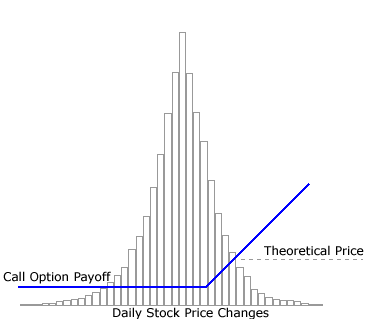
Some financial instruments are priced and valued strictly on the amount of price change and probability of occurrence. In particular, Call and Put Stock Options are priced this way. As seen below, a call option price increases when the stock goes up, but this is based on a probability weighted amount. Thus, the stock price change movement must be positively larger than the initial premium paid in order for the investor to earn a profit.
Source: Option Pricing Models
Similarly, poker player make similar decisions based on probabilities. Consider a 5 card stud player that remains until all 5 cards are dealt. If he holds a pair, then he knows that approximately 42% of all hands will have pair. He also knows that his hand is better than 50% of hands, and that approximately 8% of all hands will beat his. Using this information, he will then decide to call, raise, or fold.


Summary
In this brief article, we illustrated how similar investors and gamblers are in decision making. Underlying each conscious decision is the understanding of the underlying mathematical probabilities of successfully earning a profit. While the investments or games may vary from simple (buy a stock or flip a coin), to complex (derivative options & swaps or poker and backgammon), nearly the same mathematical properties can be used to quantify success.

Tuesday, March 29, 2011

Investing or Gambling? Part 7: Profile of a Typical Investor and Gambler

When we first began researching the profiles of typical investors and gamblers, we found many sources describing gamblers but relatively few discussing investors. The information we read about gamblers was written from either the "problem gambler" viewpoint, or that of a "casino operator". The investing articles were written for purposes of attracting "day traders" to discount brokers, or describing why investors typically lose money.

Rather than summarizing this information once again, we decided to explore the underlying traits and skills that both participants exhibit.   

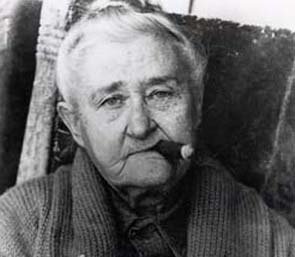
In the old days, we all have images of savvy boardroom executives smoking cigars while formulating important business decisions in a smoke filled boardroom. In contrast, we also envision the small old wiry racetrack bettor studying his racing forms while the cigar ashes threatened to fall off.

Source: Frontier Gamblers - Poker Alice
Today, we find that the cigars have mostly disappeared and that the executives and gamblers have become much much younger.

It appears that youth has overtaken our society.

But not so quick. During the past few years, our economy has faltered, leading to widespread unemployment. Executives and thousands of regular employees have been laid off. Graduates from colleges cannot find jobs in fields of their study. Out of frustration, many of these individuals have turned to gambling or investing in hopes of earning a living to support their families.

From a demographic viewpoint, we find that age has no bearing on the profile of these persons. In Wall Street, the mentality is the younger the better. They believe the younger you are, the more mathematical and abstract you think, the better you will trade. However, the major difference between these individuals and the ordinary person is that they are playing with someone else's money. These young mavericks will earn a very handsome bonus regardless of whether they win or lose.

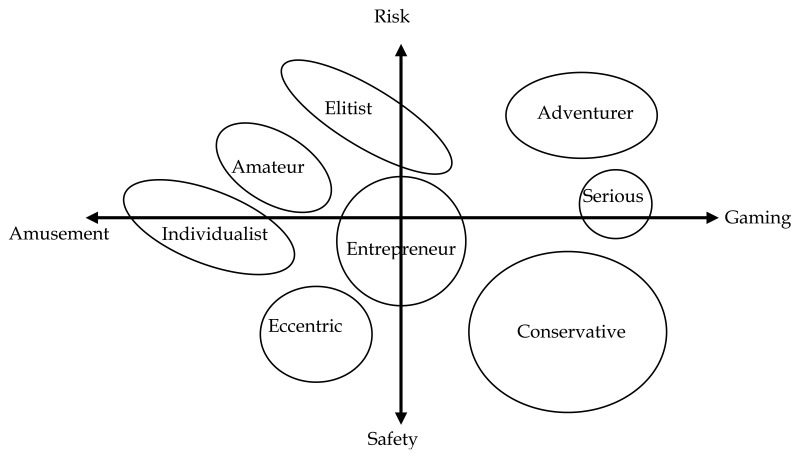
The illustration below was designed to describe the thinking of various gamblers. However, those involved in investing (or trading their own accounts) are depicted as well.  What we learn is that the average individual  is best described as an entrepreneur. They try to be middle of the road, balancing amusement with gaming while taking average risks. Whereas, individuals and amateurs lean more toward amusement, and elitists take more risk.
Source: Gambling - Contexts and addictions

According to the Forbes article, The Average Investor Is His Own Worst Enemy, average investors fail to succeed because they are overly confident, shortsighted, and have bad timing. The same is true with the average gambler.

What novice investors and gamblers believe is that they are playing on an equal level with all the other participants. Both fail to realize that they are actually playing against highly educated and highly financed professionals. These professionals have more information at there disposal, and know the underlying probabilities by heart. Consider a professional poker player. He knows his probability of winning as each card is drawn while the common individual just thinks in terms of luck. To further complicate the equation, the professionals are playing in teams while the individual is playing alone.

Whether the professionals work independently or for a company, they have dedicated their livelihood to learning their trade. Most began small and have worked their way up the income chain. Most have made associated contacts that help to keep them informed.

If you have dreams to pursue your own career as a professional investor or gambler, be prepared to study, memorize, and practice. Learn to make your own decisions but always consider the advice of others. You must always be retrospective and analyze the plays that succeeded and failed. And, never make reckless decisions, especially out of dispair.

According to Harrah's Gambling Survey 2006, successful gamblers (and we interject investors) believe they are more:
  • in control of their spending and borrowing
  • optimistic about the future
  • prepared financially for retirement
and more likely to:
  • view work as a career
  • research purchases more
  • dine out
  • have higher earnings
than the common investor. If you fit these profiles and are willing to spend years (rather than days) preparing for your future, then you too may become a successful gambler or investor as well.

Tuesday, March 22, 2011

Investing or Gambling? Part 6: Investment Options

Both gamblers and investors have a wide range of investment options in which they can place their money and hope to earn a profit. In both cases, a person puts down some money with the hope of having more sometime in the future.


Investing
From the investing side, the vehicles that are available range from near zero risk to highly leveraged and very risky strategies. The charts below illustrate various investments that a person can make, along with the associated risk taken. For purposes of this paper, we define risk as the chances of losing all or part of their money.


Source: Create Wealth Through Long-Term Investing ...
Below we have listed a number of investing options that individuals can make. Typically, most people are aware of putting their money in bank CDs and Savings Bonds. Additionally, many have purchased outright stocks, mutual funds, and sometimes commodities. As one's wealth increases, investors have branched out of these and invested in currencies, private equity companies, hedge funds, real estate, and various sports related items.
  • CDs & Bonds (Savings Bonds, US Govt Debt, Municipal, Corporates)
  • Asset Backed Bonds (Mortgages, Credit Cards)
  • Stocks
  • Commodities (Gold, Silver, Oil, etc)
  • Currencies
  • Mutual Funds
  • Hedge Funds
  • Private Equity (Small companies)
  • Collectibles (Fads, Antiques, Art)
  • Real Estate (Outright land, REITs)
  • Sports (Teams, Horses, Race cars)
Most common individuals that invest in stocks do so with the idea that they will always make money. However, that is not the case anymore. The graph below shows the Dow Jones Average from 1975 to 2008. As we can see, those who invested early were almost assured a profit. But from 1996 to 2008, there was a bumpy ride. Lots of money was lost around 2001 to 2003 and then again in 2008.


After a while, investors who have become comfortable with stocks begin to buy futures and options. These exotic vehicles allow the persons to leverage their investments by outlaying a small portion of their money and purchasing the underlying stock or bond only when a profitable return is met. The image below is a payout graph for a call option. In this example, the $40 call option would be purchased for $2 only. If the price of the stock rises above $42, then the investor would exercise his option to buy the stock at $40 and lock in a guaranteed profit. However, if the price never reached $42, then the investor would simply lose his $2 investment.


Gambling
For the gambling investor, there are numerous legalized vehicles that allow participation. Most notably are lotteries, organized parimutuel racing, casinos, and charitable games. Without ranking these in order of risk, gamblers have the opportunity to play:
  • Lottery (+ Keno)
  • Card Games (Poker, Blackjack, etc)
  • Craps (Dice)
  • Roulette
  • Slot Machines
  • Sports Games (Outcomes, Scores, etc)
  • Racing (Horses, Dogs, etc)
  • Games of Skill (Backgammon, Chess, etc)


Summary
The risks of gambling are quite different than investing. Most notably is that the event horizon is relatively short. For example: a lottery drawing may take several days before it occurs; a football or baseball game may take hours to play; a poker hand may take minutes; and a roulette spin may take seconds.


A secondary difference is that the gambler usually has direct involvement in the game, whether he is a participant or a spectator. Third, gambling payouts are usually all or nothing, win or lose. For example, only one person wins a poker hand or racing event. Investors, on the contrary, do not typically lose their entire investment.

One may argue that the gambler has an advantage over the investor because there may be an individual skill involved. While that is true, a successful investor is also skilled in understanding their own underlying products. Thus, they too have control over their destiny.

Lastly, many may say that gambling only involves luck. That can also be said about investing. Luck has a lot to do with timing and market sentiment as well.

Tuesday, March 15, 2011

Investing or Gambling? Part 5: Spotlight on Successful People

Doyle Brunson in 2006 World Series of Poker - ...Image via Wikipedia
We are all enamored by the success stories of many individuals. For those of us interested in investing, we have role models that we wish to emulate. Similarly, for those of us who wish to be successful gamblers, we point to those people who have made it big and say we can do it too.

Below,  we have highlighted six practitioners from both the gambling and investing professions who have made significant contributions to their societies and amassed a fortune at the same time. The list is intended to be a cross-section of representatives who have helped their professions advance. The list is not prioritized nor is it complete, as there are many more people who have succeeded as well.


Successful Gamblers

Doyle Brunson: Considered to be the patriarch of modern poker, this famous gambler revolutionized poker in 1978 when he published his book called Super System. Times were not always easy for this Texan who went to college on basketball and track scholarships. But, after he shattered his leg in an accident, and was diagnosed with terminal cancer in 1962, this legend learned to become successful playing the game that he loved. Quote: Through the years I've never stopped doing things, thinking about things, and I still think young.

Gonzalo Garcia-Pelayo: A Spanish mathematician and record producer who believed that roulette wheels were not completely random. Began to exploit the game by recording winning numbers on thousands of spins, and then analyzed the data. Afterward, he used this data to win over €2 million.

Dominic LoRiggio: Became famous for controlling dice while playing Craps. Learned the skill through years of practice and identified ways to set, grip, and toss the dice to achieve a desired roll. Called the Dominator, he says it is a matter of simple physics. Claims to have won thousands of dollars at various casinos.

Edward Thorp: The creator of card counting, a technique by which a player can keep track of the cards that are played and those left in the deck. Most notably recorded in his 1962 book called Beat the Dealer. He has a M.A. in Physics and a PhD in mathematics, and taught at M.I.T. He published a second book in 1967 called Beat the Market and then started a derivatives based hedge fund.

Admiral Henry John Rous: Devised the first methodology for handicapping horse racing. It was based on the Weight for Age Scale which tabulates results based on a jockeys weight and a horses age.


Billy Walters: One of the instrumental managers of The Computer Group, a sports betting operation, that won millions by analyzing all the statistical data about the teams, weather, and more. The Computer Group was forced to break up in 1987, but Billy Walters has continues to win annually using a team of associates who specialize in various aspects of the games.


Successful Investors

Myron Scholes: Co-inventor of the Black-Scholes Option Pricing Model, he was a managing director and co-head of fixed-income derivatives at Solomon Brothers. Then, he co-founded the hedge fund, Long-Term Capital Managment which obtained annualized returns over 40%. The fund failed in 1998 after losing $4.6 billion in four months. He is now chairman of Platinum Grove Asset management.

Tutor Jones: the founder of Tudor Investment Corporation. Later organized the Tutor Group that includes the former and a variety of affiliates. Is actively involved in trading, investing research and more. Current estimated net worth is $3.2 billion. Quote: The most important rule of trading is to play great defense, not great offense.

Warren Buffet: Formed Buffet Associates in 1956 with 7 limited partners and $150,000. Buffet used $100 of his own money. After 10 years, his assets rose by 1,156%.  Then he bought control of Berkshire Hathaway and became Chairman in 1970. Now has net worth of $47 billion. Quote: Rule No.1: Never lose money. Rule No.2: Never forget rule No.1

Peter Lynch: Earned the reputation of being one of the best stock-pickers in the world after managing Fidelity Magellan fund from 1977 to 1990. Those who invested $1,000 in 1977 would have worth of $28,000 in the 13 years during his control. Favorite Principal: Invest in what you know.

Benjamin Graham: The Father of security analysis and value investing. Wrote two books on these topics in 1934 and 1949 which are considered to be requites for all investors. A mentor and early employer of Warren Buffet. Principle: Know What Kind of Investor You Are

George Soros: Co-founded the Quantum Fund in 1970 at age 40. Aquired most wealth by acheiving  returns of 4000% during the next 10 years. Is now estimated to have $11 billion. Quote: The financial markets generally are unpredictable. So that one has to have different scenarios.. The idea that you can actually predict what's going to happen contradicts my way of looking at the market.

Michael Moritz: A journalist for Time that became a Venture Capitalist two years later in 1986. Joined Sequoia Capital and had made huge returns by investing in Google, Yahoo, PayPal, and many others. Fell out of the Billionaires club in 2008, but still has lots more money.


Summary
By reading the stories of the individuals above, we can identify certain traits common to all. First, most are highly educated.  They all share a deeper knowledge of mathematics and used this skill as a tool to analyze their content. All are hard working and highly dedicated. Success didn't come overnight, but after years of studying, practicing, and hard work.

For us to succeed then, we must conclude that we can't give up. Some have made mistakes, earning a fortune and then losing all or part of it. However, they never gave up on their pursuits and all succeeded in the long run.
Enhanced by Zemanta

Tuesday, March 8, 2011

Investing or Gambling? Part 4: The differences between the two.

Thoroughbred racing at Churchill Downs.Image via Wikipedia
There are two primary differences between investing and gambling:
  1. Ownership of an asset, and
  2. Entertainment.
First, in investing, an investor purchases an asset with the expectation that it will appreciate in value and be worth more in the future than it is at the present time. When gambling, a participant also invests a certain amount of money with the anticipation of winning. However, most gamblers understand that the chances of losing their investment far outweighs their chances of winning.

Second, gambling is entertainment, it is fun. Many people love to go to casinos to play the slots, poker, roulette, or craps. Whether they return home with the same (more, or less) amount of money, the person is usually happy knowing that they purchased a few hours of entertainment. To the lottery player, they have purchased a day or two of dreams. However, investing is work and that is not typically fun. Except for those who purchase antiques or collectibles, an investor obtains very little entertainment value.

Similarities
Aside from the outlay of money, there are few similarities to investing an gambling. In these, both:
  • Risk capital to earn a profit.
  • Are trying to predict the future outcomes of a certain event.
  • Require skill to be successful.
  • Are subject to external manipulation.
  • Hope to get rich.
  • Can lose money.
  • Value may be arbitrarily contrived.
Examples of Investing and Gambling
InvestingGambling
StocksLottery
BondsPoker
CoinsBackgammon
Real EstateHorse Racing
OptionsCraps
Cars & HorsesSlot Machines
CollectablesFootball Games

Differences
 When considering the two, there are many more differences between investing and gambling that can be identified:
  • An investor's time horizon is endless, whereas a gamblers horizon is fixed.
  • An investor expects to earn a profit, but a gambler expects to lose.
  • The financial return on most investments is quantified, but a gambler's is infinite.
  • Investing returns are incremental, but gambling is all or nothing
  • An investor's asset fluctuates based on supply and demand. A gambler's asset changes only on anticipated success.
  • Investors do not typically influence the value of their asset. Gamblers have direct control over the value of their asset.
  • Investors rarely lose their entire investment. Gamblers usually lose most of the money wagered.
  • Investments are subject to economic pressures. Gambling games have no economic pressure.
Negative, Zero, and Positive Sum Games.
Most educators consider most forms of gambling to be Negative Sum Games. This means that less money is returned back to the players than the money raised. However, economists liken investing to a Zero Sum Game, meaning that all the money invested is returned back to the investors. Depending on your viewpoint, this may or may not be true. For example, assume that you bought an asset that was destroyed in a fire, lost or stolen. Unless you had insurance (and paid more for this risk), you would lose your entire investment. Depending on the type of asset, others may then become more valuable, or not change in value at all. Investing in bonds can be a Positive Sum Game to the purchaser. Depending on the security, there would be very little risk of losing money, and the payouts would certainly exceed the amount invested.

Summary
In summary, most investors and gamblers participate with the ultimate intention to earn more income. Investors utilize their financial capital to purchase assets that they hope will appreciate. Gamblers, on the other hand, play games with the hope of winning money. Both want to become rich and are faced with skillful competition that can out buy or out play them. Thus, our conclusion is that both these are risky and the unprepared are subject to losing all or part of their money.
Enhanced by Zemanta

Tuesday, March 1, 2011

Investing or Gambling? Part 3: Why Its Important.

Americans are enamored by wealth. We all dream about being independently wealthy, working as little as possible, and obtaining the most amount of money as possible. But, the harsh reality is that very few of us achieve our goals of becoming millionaires.

For the past few years, the United States has been in a recession. Many individuals have lost their jobs and have remained unemployed for two years or more. At the same time, students graduating from college have found it increasingly more difficult to find employment opportunities. Many students have taken the opportunity to earn a Graduate degree with the hope that they will be more marketable when they finish their advanced education.

People are desperate.

With financial pressures mounting, many unemployed individuals have sought alternate avenues for generating family revenue. Some have become day traders, and others have become professional gamblers.

Temptation is everywhere.

The radio and television advertisements are full of get rich quick schemes, telling us to buy gold, refinance our houses, play the stock market, play the lottery, go to a casino, and more. We are bombarded with stories of successful investors such as Warren Buffet, George Soros, Donald Trump, and Wall Street tycoons who made fortunes playing the markets. At the same time, we see the glamorous lifes of the ESPN World Series of Poker stars, and hear about the fabulous casino and lottery winners.

Taking a gamble.

In the past, the division between gambling and investing was clearly defined. Our images of gamblers were those betting at race tracks, the down on their luck poker player, or the gambling addict. Investors wore suits and ties. They attended meetings and lunches, and put together multi-million dollar deals that rewarded them handsomely.

The internet breaks the barriers.

But with the recent advances in technology, the trading tools previously available only to those in the investment business are now available to all of us. We can now learn to use technical trading tools right in our home for buying and selling stocks. As we learn more, we can buy more exotic products, like options. A few years ago, everyone could play online poker. Although this is now banned, players can continue to refine their skills by playing for fun on a variety of sites.

This past January, 60 Minutes aired a Sports Bedding feature on Billy Walters, a sports betting legend who has never had a losing year.


Because temptation is everywhere, many individuals are attempting to earn a living as either a professional investor or a gambler. I have several friends who stopped working years ago and now earn their income solely from trading stocks. Lately, I've seen a few young college graduates decide to become professional poker players in Atlantic City and Las Vegas, rather than working in the corporate world.

Everyone wants your money.

What I've learned from analyzing lottery games and talking to these individuals is that achieving success is difficult.  Everyone out there wants your money. The more desperate you are, the easier it is to lose everything. Regardless of whether you participate in investing or gambling, you are competing against professionals that have much more money and much more knowledge. They all know the odds of winning and losing, and make their bets accordingly.

Don't be a fool.

Therefore, we felt that it is important to write this series of articles about investing and gambling. In last weeks article, we defined these two concepts and showed how they are different. In subsequent weeks, we will illustrate why the distinction between the two is blurred. In the end, we hope to educate you to the risks of each profession, and to help you keep your hard earned money.

Tuesday, February 22, 2011

Investing or Gambling? Part 2: The Definitions

In this second installment of our analysis, we will examine the definitional differences between gambling and investing. This information will form the basis by which we will judge future comparisons of each discipline.

To begin, there are fundamental similarities and differences between gambling and investing. Both involve a participant's initial outlay of money for purposes of receiving future payments that exceed the investment amount. The definitions below describe the expectations that each monetary outlay will purchase.


Investing Defined
Those who invest receive partial or full ownership of a physical asset, whether it be a company, commodity, real-estate, manufactured good, production rights, etc. which can be redeemed at a future date at the discretion of the owner. The vast majority of investors typically have no direct financial control of the asset. Appreciation of value is acheived based on fundamentals of supply and demand, and operating efficiencies. When an asset grows in value, an investor may realize a profit on his investment; and when an asset drops in value, the investor may incur a loss. But, the actual profit or loss is only realized when the investor sells the asset. The key here is that the investor has the sole opportunity to act.

Definitions


Gambling Defined
Gambling involves purchasing the right to participate in the possible ownership of a product or prize based on a certain outcome of a particular event. Depending on the prize structure, a gambler only receives income if his predicted guess correctly matches the ordered result of the event, such a lottery drawing, horse race, the win or loss of a sports team, a poker hand, etc. Once the event is completed, the gamblers asset value (if any) is returned to the player. These investors either win or lose, and the participation right is valueless once the event is over. Important here is that gamblers have no influence over the outcome of the event.

Definitions
  • To play a game for money or property (Merriam-Webster)
  • To bet on an uncertain outcome
  • To bet on an uncrtain outcome, as of a contest (TheFreeDictionary)
  • To play a game of chance for stakes
  • To take a risk in the hope of gaining an advantage or benefit


Three Major Distinctions
From the definitions above, we can identify three major distinctions between investing and gambling.

First, the primary distinction between investing and gambling is ownership of an asset. An investor purchases an asset of value whereas a gambler purchase an outcome. The investor's asset maintains value for the life of the asset. Whereas, a gambler's outcome has no value in itself. The only means of profit is derived from the investments of the other gamblers involved.

Secondly, an investor's asset derives value from market demand, which can cause the value of the asset to fluctuate. However, a gambler's asset has value limited by the expectations of others. Any changes are based on parimutuel betting odds or a gambler's expectation of winning. Please realize that neither of these are physical factors.

Third, an investor has an option to sell his asset. But, a gambler's asset rarely has any secondary retail value. It's not very often that: a race track bettor or lottery player will sell his ticket; or, a poker player will sell his hand. But stock market and bond investors continually buy and sell these assets.


Hidden Ambiguity
Occasionally, the lines of distinction between investing an gambling can appear to be blurred. For example, consider an options investor. In this case, the investor purchases the right to buy (or sell) an asset for a predetermined period of time. At the expiration of the term, the asset may or may not have any value. This sounds like gambling.

However, two things differentiate options investing from gambling. First, there is an underlying physical product to the option. Second, the investor has the opportunity to sell, exercise, or expire the option. These are all directly under the investors control.


Summary of the Subtle Similarities
Both successful gamblers and investors understand that favorable outcomes involve probabilities. The skilled player of both professions understands the risks and chances for success. They invest (bet) accordingly.

Both are investing in the unknown. Neither the investor or gambler knows what will happen in the future,  but both are willing to invest their earning with the hope of receiving a future profitable payout.


In our forthcoming articles, we will utilize these definitions to clarify and identify the differences and times to show when investing becomes gambling, and when gambling becomes investing.

Tuesday, February 15, 2011

Investing or Gambling? Part 1: Introduction

The New York Stock ExchangeImage by BlatantNews.com via Flickr
When we first created our website and blogs, we strongly believed that playing the lottery was not gambling. Our thought was that since the chances of winning a jackpot prize was so small, one could not realistically gamble on their winning. To us, gambling involved having a reasonable expectation of winning. In games such as Powerball and Mega Millions, it is nearly impossible to have this expectation. Thus, we concluded, these games were not gambling.

However, as we began to study smaller games, such as the Pick 3, we realized that given the right circumstances, a player could achieve a reasonable expectation of winning. In these cases, we do not believe one can expect to receive a mutli-million dollar windfall, but perhaps a continuous 10% or 20% return was possible.

Considering these realistic return percentages, we began to compare realistic returns that investors achieve in the stock or other markets. In good times, a stellar fund may reward investors with similarly high rates of returns. So we wondered:

Can Gambling be Considered Investing?
or
Is Investing Gambling?

To help understand these answers, we have decided to write an investigative comparison of both gambling and investing.

In the issues that follow, we will present:
  1. The definitions of investing and gambling
  2. Outline why this topic is important at this time
  3. Identify the differences between the two of these
  4. Present examples of successful investors and gamblers
  5. Examine various gambling games and investment options
  6. Look at the profile of a typical investor and gambler
  7. Compare the mathematics involved in both disciplines
  8. Consider whether the outcomes can be manipulated
  9. Conclude by quantifying whether investing is also gambling.
During the next 9 weeks or more, we will address each of these topics in detail.  We will try to illustrate the differences between the two concepts and reinforce why all folks should be conservative with their investments. At the end of this series, we will, hopefully, reach a solid conclusion about whether investing may also be gambling; and perhaps more importantly, why you should even care.
Enhanced by Zemanta

Tuesday, February 1, 2011

A Revised Look at the Mega Millions Megaplier Option

Introduction
When the Mega Millions and Powerball lotteries began cross selling in the previous proprietary States in early 2010, the Megaplier Option was immediately available in the original Powerball states. This has been a popular option to increase prize payouts especially when the Jackpot prizes were low. To help stimulate even more interest, Powerball established a fixed $1 million second place prize for those players who bought the Powerplay. This change helped to increase sales of this option.

To keep pace, Mega Million states pushed to implement the Megaplier. More importantly, the Megaplier second place prize was also increased to a guaranteed $1 million as well. At the time of this writing, nearly every state that sells Mega Millions tickets now offers the Megaplier Option with a fixed $1M prize for those fortunate to match all 5 of the white balls, but not the Megaball.

Thanks to a comment written by an Anonymous author, we were alerted to the recent prize structure change. This post provides the an up-to-date revision of our original Megaplier research post written in December 20007 entitled Should You Buy the Power Play, Sizzler, or Megaplier?

As Mega Million lottery interest has grown since the January 2011 record Jackpot of $355 milllion, many players continue to ask:

Should I Buy the Megaplier Option?

As originally advised,
The correct answer remains both Yes and No!
It depends on the size of the Jackpot,

And Your Strategy.

How would you know when to buy it?
If your lottery playing strategy is to win the Jackpot, we advise that you always buy the Megaplier option whenever the current jackpot value is below its Jackpot Breakeven level.
  • For Mega Millions, Breakeven is now $53.1 million: Buy the Megaplier Option whenever the Jackpot is below this value. Never above this. Buy 2 tickets instead.
However, if you strategy is to maximize your prize winnings by religiously playing a consistent set of  numbers, we recommend that you always buy the Megaplier.


Effect of Change?
Because the 2nd place prize is now always fixed, the amount of money returned to Megaplier players has also increased. The net effect of this increase means that the Mega Millions breakeven has increased by $5.9 million from $47.2M to $53.1M.

Note, however, that as the Jackpot increases above its minimum, only the probability weighted amount of jackpot money returned to players increases. This means that all other prize payouts are fixed. Thus, there is always a fixed point (jackpot level) at which the return of single ticket payouts equals the return of the Megaplier ticket payouts.

As lottery players, we want to play the option that returns the most money back to us, the players. As you will see below, your option changes depending on the jackpot level.


Mega Millions Megaplier
When a player buys the Megaplier option, all  prizes that the player wins, except the Jackpot, will be multiplied by either 2, 3, or 4, depending on what Megaplier was selected. Additionally, the new rules fix the 2nd place prize Megaplier multiplier at 4, regardless of what was picked. This means that the top non-jackpot prize for matching 5 white balls is always $1,000,000. Accounting for this new change, the probability weighted average of all other non-jackpot prizes remains at a multiplier equal to 3.476 times.

Based on this information, the graph below illustrates both the expected Megaplier return (in blue) against the expected return of a single Mega Millions ticket without the Megaplier (in red).

When the jackpot is set to the minimum $12 million, Megaplier returns $0.367 (increased from $0.350) of each dollar received, compared to $0.250 for those without the option.

When the jackpot level reaches $53.1 million, both tickets with and without the Megaplier returns $0.484 of each dollar received. We refer to this $53.1 million as the Jackpot Breakeven level. (Note that previously, the breakeven return was $0.451 at a $47.2M level).

Above this breakeven level, tickets purchased without Megaplier return more to the players. When the jackpot grows to $90 million, $0.694 is returned to straight ticket holders compared to only $0.589 (previously $0.572) to those who bought the Megaplier.


Megaplier chart


Because the new Megaplier rule is now in effect in most Mega Millions states, the overall monetary return of money received has increased.


Conclusion
We suggest that all lottery playersshould purchase Lottery Tickets like they would any other investment, and always seek the highest return on their dollars. Thus, when the Mega Millions jackpot is below $53.1 million, the Megaplier should be purchased. When the jackpot is above this level, never purchase the Megaplier. Go for the Jackpot instead.


Learn More
To learn more about this subject, visit our in-depth pages that provide the detailed numbers behind each of these options.

Related Posts Plugin for WordPress, Blogger...